

Hyundai Palisade vs Ford Explorer

Hyundai came out with a new 3-row SUV for the model year in the form of the Palisade. If you’re in the market for a new SUV, you may be wondering how this model stacks up against other 3-row SUVs out there.
Today, Norm Reeves Hyundai Superstore Cerritos is comparing the 2021 Hyundai Palisade vs. Ford Explorer. Both SUVs offer several features and interior comforts for Puente Hills, Anaheim, and Garden Grove, CA, drivers. So, which one should you take home? Find out in our Hyundai Palisade vs. Ford Explorer comparison. Contact us today for more information.
Passenger Comforts
 Both SUVs offer seating for seven, with a 3rd-row bench seat and available 2nd-row captain’s chairs. If you often drive your kids and their friends around town, you’ll have more space in the Palisade. It comes standard with a 2nd-row bench seat, increasing the total seating to eight. Meanwhile, certain Explorer models can only seat six.
Additionally, there’s more overall passenger space in the Palisade, meaning you and your riders will be more comfortable. This is especially noticeable when it comes to legroom. The 2021 Hyundai Palisade has 44.1 inches of legroom in the front and 42.4 inches in the second row. Compare that to 43 inches of front-row and 39 inches of 2nd-row legroom in the Explorer.
Ventilated seats are a great way to keep cool when the hot summer sun is beating down on you and your passengers. Luckily, the Palisade and Explorer offer this feature for the front seats. The Palisade takes it a step further, though, offering ventilated second-row seats as well.
Cargo Options
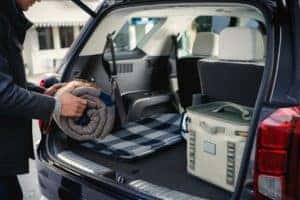
When it’s time to carry set pieces for the local theatre production, both SUVs offer nearly equal cargo space. Accessing that cargo area is easy in both vehicles, too, thanks to available hands-free liftgates.
In the Explorer, this optional feature is activated with a gentle swipe of your foot under the rear bumper. It’s even easier in the Palisade. Simply stand behind the vehicle with the Proximity Key in your purse or pocket, and the liftgate will open for you.
Each SUV offers spacious cargo areas for when you’re looking to pack for an adventure. Additionally, the Palisade and Explorer include at least 18 cubic feet behind the third row, which expands to more than 85 cubic feet when the second and third rows are folded flat to optimize the cargo space.
While each vehicle offers plenty of space over three rows of seating, the Hyundai Palisade offers 173.3 cubic feet of cabin space for passengers and cargo. The Ford Explorer, however, falls behind slightly with 170.9 cubic feet of passenger and cargo space.
Multimedia Systems
We were really impressed when we saw that the Ford Explorer was offering a 10.1-inch touchscreen display. But then we saw the 10.25-inch touchscreen available in the Hyundai Palisade.
 Sure, the available Hyundai SUV display is slightly larger, but its design is what really stands out. Its horizontal design is one with the dashboard, giving a sleeker overall look. Ford has come a long way with its multimedia systems. Still, its large, vertically-oriented display simply looks like someone placed a tablet on the dashboard without integrating it into the interior design.
When it comes to the Hyundai Palisade vs. Ford Explorer, both infotainment systems allow you to connect to Apple CarPlay®, Android Auto™, and a slew of other options. These features will integrate your phone, so you can access your media, apps, text messages, and contacts on your phone directly from the touchscreen. Both SUVs also offer ample charging options, including Qi-compatible wireless charging stations.
The new Hyundai Palisade also makes it easy to talk to passengers all the way in the third row using the available Driver Talk In-car Intercom. Meanwhile, quiet mode—standard on the Palisade—turns off the rear speakers, so your little ones can sleep in peace. Neither of these options is available in the Explorer.
Advanced Safety Features & Technology
One factor that most family-oriented SUV drivers will appreciate about both of these vehicles is that they include the latest in smart safety driving-assistance. These features use exterior-mounted sensors and on-board cameras to measure factors like lane position, the speed of the vehicle, and its proximity to other vehicles on the road.

Using these technologies, the features will calculate the rate of approach or lane departure and the likelihood of a mishap. They’ll then activate the appropriate features and send a warning to the dashboard while using braking power to give you a window of time to react and prevent an issue on the road.
When it comes to the Hyundai Palisade vs. Ford Explorer, both SUV offer similar features in the form of collision avoidance and lane-keeping systems to ensure your safety and security on the road. However, there are a few differences in some of the other features.
The Hyundai Palisade, for instance, offers Smart Cruise Control with Stop & Go. This feature allows you to use your cruise control with a pre-determined distance between the vehicle ahead, and it will keep that safe distance despite the flow of traffic.
The Palisade also includes the Driver Attention Warning System. This feature will recognize distracted driving over long periods of driving. It will emit a warning to ensure that you’re alert. It will also recommend break times during lengthy treks.
While the Ford Explorer offers plenty of driver-assisting features, it doesn’t include these last two additions. It comes standard with a pre-collision system and a lane-keeping system. Any additional driver-assisting feature can be added by upgrading the Explorer to a higher trim level.
Hyundai Palisade vs Ford Explorer: Test Drive Our Top Pick
 When it’s time to choose a 3-row SUV for Puente Hills, Anaheim, and Garden Grove, California, Norm Reeves Hyundai Superstore Cerritos recommends the new Hyundai Palisade. Not only can this Hyundai SUV carry more passengers, but it also offers more high-tech features to make the ride more enjoyable and safe for everyone on board.
Ready to learn more about this new Hyundai SUV? Contact us today to schedule a test drive! You’ll be able to tell if it’s the right choice for you, your family, and your adventures on the road.